By Mashood Ahmad
CEO, Gigabit IQ and ISPA UK Board Member, discussing the implications of the Online Safety Act
The Online Safety Act is now one of the UK’s most ambitious digital safety laws — introduced to make the internet safer for everyone, particularly children and vulnerable groups. It was created in response to rising public concern about online harms: from grooming, cyberbullying, and exposure to pornography, to the spread of illegal content and the promotion of self-harm.
Before the Act, online platforms had not been held fully accountable for user safety. The Online Safety Act now gives Ofcom strong powers to enforce standards, drive the use of robust age verification, and require tech companies to take stronger action to protect users. Its core goal is simple; to make the UK the safest place in the world for children to be online, while holding Big Tech to account.
As the Act moves from legislation to real-world implementation, much of the public debate has focused on platform accountability. However, the conversation cannot stop there. If we are serious about keeping kids safe online, the Act must also evolve to engage another critical part of the digital ecosystem: Internet Service Providers (ISPs).
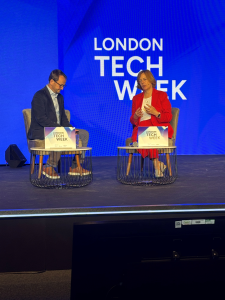
At London Tech Week 2025, I heard these issues discussed first-hand in a fireside chat with Dame Melanie Dawes, CEO of Ofcom, and raised them directly with Sir Chris Bryant MP, Minister of State for Data Protection and Telecoms. The message was clear: while progress has been made, the Online Safety Act must continue to evolve if we are to meet the challenge of harmful content online.
What Ofcom has done so far: Enforcing the Online Safety Act on platforms
Ofcom has taken significant early steps to turn the Online Safety Act from legislation into meaningful enforcement. Online safety – Ofcom
Since the Act came into force, Ofcom has:
-
Issued codes of practice and guidance on how platforms must tackle illegal and harmful content, including material that promotes knife crime and other forms of violence.
-
Opened nine new investigations into social media platforms suspected of allowing illegal content to spread in violation of their duties under the Act. This is one of the first major waves of enforcement activity, aimed at holding platforms to account. Enforcing the Online Safety Act: Ofcom opens nine new investigations – Ofcom
-
Launched investigations into several online pornography services over failures to implement adequate age verification measures. This marks the first use of Ofcom’s new powers to protect children from accessing pornographic content online, a critical test case for the regulator’s enforcement powers.
-
Published detailed guidance on how the Online Safety Act will help tackle knife crime, by requiring platforms to take action against posts that glorify or promote weapons-related violence.
In addition to this enforcement activity, Ofcom has emphasised that the experience of children and young people online is a central focus of its work. In her talk at London Tech Week, Dame Melanie Dawes acknowledged that the Act is now entering a critical phase:
“Now we need to see the action… It’s about turning the spotlight now on the industry.”
Dame Melanie Dawes has consistently said that Ofcom will measure success not just by industry compliance, but by whether the online experience is safer and healthier for children in practice:
“What is it like to be a teenager online? How easy is it for you to come across really nasty, dangerous material? Is it getting better?”
These are exactly the right questions to ask, and ISPs are uniquely positioned not only to help answer them, but provide the tools for parents to self-manage their families online activity
Discussion with Sir Chris Bryant MP, on the the role of ISPs in supporting the Online Safety Act
ISPs operate the networks through which almost all online content flows. The vast majority of UK households, including families with children, rely on these networks to access the internet every day. We provide the digital highways that carry content from platforms to homes, schools and workplaces across the country.
Yet despite this central role, ISPs remain largely on the sidelines of the current Online Safety Act framework. So far, the Act’s focus has been on regulating the platforms themselves.
At London Tech Week, I raised this issue directly with Sir Chris Bryant MP, Minister of State for Data Protection and Telecoms and Minister of State for Creative Industries, Arts and Tourism. I asked whether ISPs should be given a more clearly defined role in helping to protect children and families online.
His response was both welcome and encouraging:
“The Online Safety Act must evolve, and ISPs absolutely should have a role to play in the next iteration.”
This recognition is vital. Without a fully engaged ISP sector, the Online Safety Act will struggle to deliver the holistic protections that children, families and all internet users deserve.
How ISPs Can Help Keep Kids Safe Online
ISPs bring important capabilities to the online safety ecosystem. We manage the networks that families and children use to access the internet and can apply protections that complement platform-level controls.
Network-level parental controls and content-based filtering allow ISPs to block harmful or age-inappropriate material before it reaches any device in the home. Unlike app-based controls, these protections apply to all connected devices, including gaming consoles, smart TVs, tablets and IoT devices. This is essential, as children’s online activity spans far beyond smartphones. According to Ofcom, 89 percent of children aged 3 to 17 play video games, 54 percent use laptops or desktops daily, and 64 percent use tablets daily. (Ofcom Children & Parents: Media Use & Attitudes – 2023)
ISPs also provide visibility across all devices on a home network, filling the gaps left by platform protections. Many children access content through shared or guest devices or apps that lack robust age verification. Network-level controls help ensure consistent protections, regardless of device or login.
Supporting parents is a critical role. Most parents do not have the time or expertise to configure safety settings across every device and app. ISPs can simplify this through opt-in network-level controls, giving parents a single point of control for content filtering and device access.
Finally, ISPs can help create safer digital highways by proactively blocking known harmful content and collaborating with platforms and regulators to reduce the spread of dangerous material at the network level. This is a role that only ISPs can play and must become a core part of the UK’s online safety strategy.
Gigabit IQ’s Commitment to Digital Safety
At Gigabit IQ, we are already working to demonstrate what an ISP-led safety model can look like.
Our broadband services embed:
-
Award-winning parental controls that are simple for parents to use
-
Age-based content filtering aligned with UK safety standards – Family Guard+ Internet Parental Controls – Gigabit IQ
-
CyberGuard+ cybersecurity protecting against online threats – CyberGuard+ Internet Security – Gigabit IQ
-
Managed Wi-Fi that secures every device connected to the network – Ultimate WiFi | Home Wi-Fi Experience – Gigabit IQ
We take this responsibility seriously because I believe that if a broadband service is not safe enough for my own children, it is not safe enough for anyone’s. As a parent of five and an industry leader, I will continue to champion the role of ISPs in building a safer digital future. Furthermore, we have extended our Safer Internet services beyond the realm of our own broadband, by providing the service to any customer on any broadband service, so that all families can ensure protection for their children via our award-winning Gigabit IQ app, click on the following link to get safer internet today – Safer Internet | Internet Parental Controls – Gigabit IQ
A Call to Action: Join the Conversation on Reforming the Online Safety Act
Gigabit IQ is proud to sponsor the upcoming Internet Service Providers’ Association (ISPA) Parliament & Internet Conference on 8 July 2025 at Portcullis House. This important event will bring together policymakers, regulators, industry leaders and safety advocates to explore how the Online Safety Act can evolve to better protect children and families, with ISPs playing an active role.
At the conference, we will advocate for three key priorities:
-
Formal engagement of ISPs in the next phase of the Online Safety Act
-
Universal availability of opt-in parental controls across all ISPs
-
Stronger collaboration between Ofcom, government and the ISP industry
We invite all policymakers, industry peers and civil society organisations to join us in this effort. Digital inclusion must go hand in hand with digital safety.
If you believe that keeping children safe online should be a shared responsibility, now is the time to make your voice heard.
Contact your MP today and urge them to:
-
Attend the Parliament & Internet Conference on 8 July: https://www.ispa.org.uk/event/parliament-internet-conference-6
-
Support formal ISP engagement in the next phase of the Online Safety Act
-
Back calls for universal opt-in parental controls across all ISPs
You can find your MP’s contact details here: https://members.parliament.uk/members/commons
Together, we can help ensure the UK builds the world’s safest digital highways for children and families.
Stay Involved: Help Us Build a Safer Internet for Families
The conversation around reforming the Online Safety Act is just beginning — and the role of ISPs must be part of it.
At Gigabit IQ, we believe the UK can lead the world in making the internet a safer space for children and families. But this will only happen if policymakers, regulators, ISPs, and civil society work together.
We invite you to join us:
-
Sign up for updates from Gigabit IQ as we continue to lead the conversation on ISP-driven online safety and parental controls. Contact Gigabit IQ – Ultrafast Reliable Broadband
-
Contact us if you are a policymaker, charity, educator, or industry leader who would like to collaborate on advancing ISP-led online safety innovation.
Because every child deserves a safer internet — and together, we can make it happen.