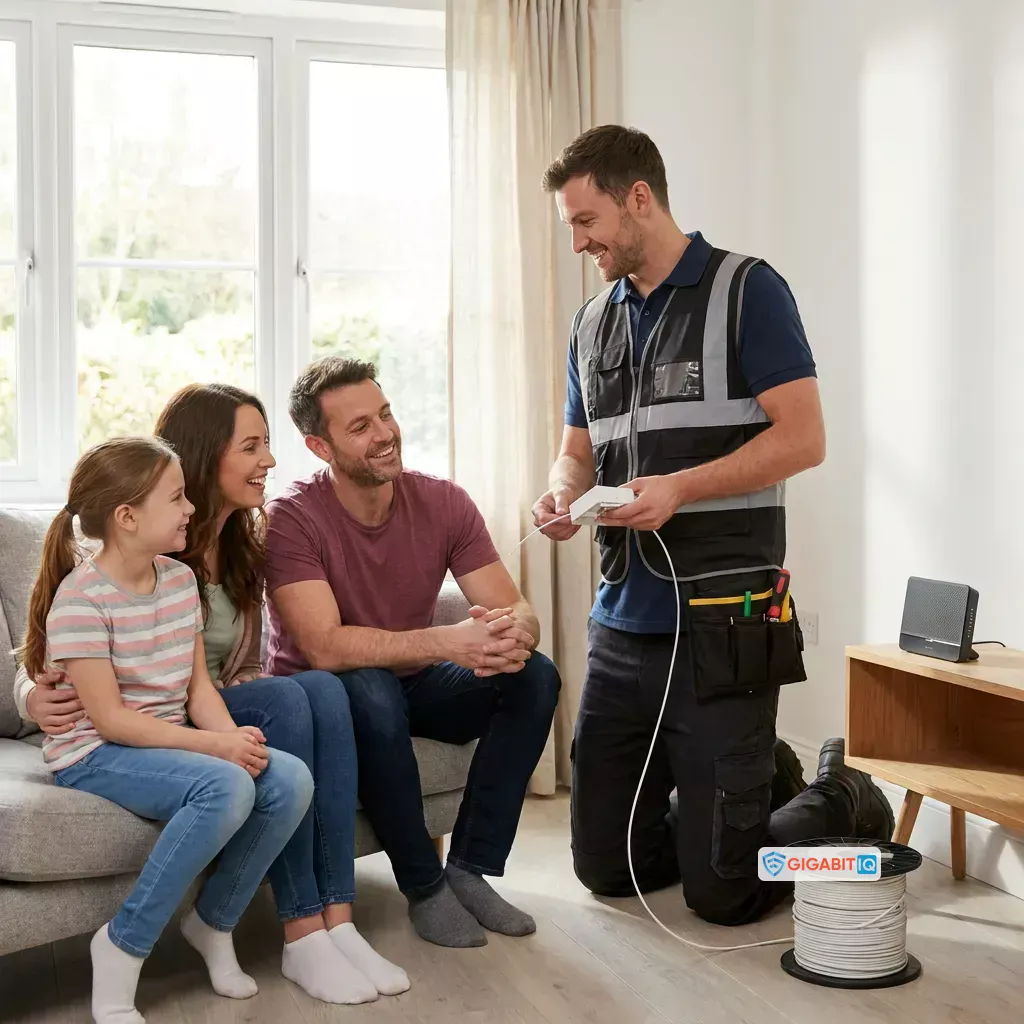
A full-fibre installation has outside and inside stages
A UK home full-fibre installation usually has an outside stage and an inside stage. If the fibre line is not already at your property, it is brought from the street network; equipment is then fitted inside and the connection tested. The outside work may already be complete, so the visit can involve less work at the property than you expect.
Full fibre replaces the older copper section with a fibre-optic cable. That is the useful distinction to keep in mind when you compare installation descriptions: ask what connection is being brought to your home, rather than assuming that every use of the word “fibre” describes the same work.
Think of the process as a sequence, not one fixed appointment plan: outside work may be needed first, then the cable is brought indoors, equipment is fitted and the connection is tested. Which steps apply depends on what is already in place and the arrangements for your property. The practical questions are therefore simple: what has already been done, what remains, and what will happen at your home?
Check whether the outside network work is already complete
Outside readiness affects what is left to do before the indoor equipment can be fitted. If your address is marked ready for service, the outside work may already be done; if it is not, extra steps may be needed before the installation appointment. The status is a useful starting point, not a complete description of the work planned for your home.
Before you book, ask the provider:
- Is the fibre line already brought to my property, or is outside work still needed?
- Does “ready for service” mean the outside work at my address is complete?
- Are any additional steps expected before the indoor appointment?
- Will you tell me if those steps affect the appointment arrangements?
Ask for the answer in terms of your address and the work still outstanding. A general description of the installation may explain the usual stages, but it cannot tell you which of them have already happened at your home.
A terrace in an English town, a flat in a shared building and a rural home may each prompt different questions about what is already in place. Do not assume that a neighbour’s appointment tells you what your own property needs. Ask for the outside-work status for your address, then use that answer to clarify whether the booked visit is for indoor fitting and testing or includes further work.
Ask which route the fibre would take to your home
The fibre route to your home may run overhead from a telegraph pole or underground through a duct. Which route is proposed depends on the network and your property; neither option should be assumed from a general description of full-fibre installation.
Ask the provider to explain the proposed route in plain language. For an overhead route, ask where the cable would come from and how it would reach the property. For an underground route, ask whether any work is expected along the duct and whether anything needs to happen before the indoor appointment. These are questions about the plan for your address, not a request to assess the route yourself.
Openreach guidance says your broadband provider will confirm an installation date and explain what to expect; it also says a survey may take place first if your property has unusual access requirements. If you have a long approach, a shared entrance or another access detail that might affect the work, tell the provider and ask whether a survey or other step is needed. That question is especially useful if you live in a rural part of England, where you may want the proposed route and access arrangements explained before choosing an appointment.
Write down the route the provider describes, along with any work they say is still required. If the explanation is unclear, ask them to distinguish work outside your home from the cable entry and equipment fitting inside. That gives you a more useful basis for planning than a broad answer such as “the fibre will be installed”.

Clarify the entry point and work inside the property
The cable has to reach the inside of your home, and an engineer may fit a small external box to protect the fibre entry point. A UK installation guide describes bringing the cable indoors through a small drilled hole. Treat that as an example of an installation method, not a promise that every provider will use the same approach or put the entry point in the same place.
Before the appointment, ask:
- Where is the proposed cable entry point?
- What work is planned on the outside wall and inside the property?
- Does anyone need access to a particular room or part of the building?
- What should I move or make accessible before the visit, if anything?
- Who should I contact if the proposed entry point needs discussion?
The aim is to understand the planned work before anyone arrives, especially if you are arranging access for other people in your household. If you rent, live in a flat, or share parts of a building, ask the provider who needs to be involved and whether any permission or access arrangement applies to your situation. Do not assume the answer: ask what applies to the route and entry point they have proposed.
Find out what equipment will be fitted and tested
The equipment fitted inside can be part of the installation, but the exact arrangements should be confirmed with your provider. In one published installation description, the engineer fits an Optical Network Terminal (ONT) and a provider router, then tests the connection, sets up the router and checks the Wi-Fi. That is an example, not a guarantee that every provider supplies or sets up equipment in the same way.
Ask what equipment is included in the installation and where it is expected to go. Check whether the visit includes connection testing, router set-up and a Wi-Fi check, or whether any part of the set-up is left for you to do. If you have a preferred location for the equipment, raise it before the work begins and ask whether it fits the proposed cable route.
Keep the different checks separate. A connection test concerns the broadband connection; a Wi-Fi check concerns the wireless connection in the home. Ask the provider which checks are included and what they will tell you when the work is complete.

Check building access and property-specific arrangements
Building access is worth discussing before you settle on an appointment, particularly if someone needs to open a shared entrance or arrange access to parts of the property. Openreach guidance says a survey may take place first when a property has unusual access requirements. Ask the provider whether your home needs a survey, who must arrange access, and whether the answer changes any other installation steps.
For a flat or shared building, ask whether access to a communal area is part of the proposed work and who should coordinate it. If you rent, ask whether you need to involve a landlord or another person before the work can go ahead. These are checks to make about your circumstances, not universal permission rules.
The outside work and cable route can affect what needs explaining at a particular home. If you are in a rural area, ask how the line is expected to reach the property and whether any outside steps remain. If you are in a town or live in a shared building, ask how the proposed route meets the building and where the cable would enter your home.
You do not need to choose between an overhead and underground route without the provider’s explanation. Ask which one is proposed, what it means for the work at your property, and whether anything needs to be arranged before an appointment is confirmed.
Confirm appointment arrangements and likely time on site
Openreach guidance says your broadband provider will confirm an installation date and tell you what to expect. Ask what the appointment covers, whether any survey or outside work comes first, and whether the date depends on another step being completed. This helps you distinguish the planned indoor visit from work that may need to happen beforehand.
Openreach says most installations take between one and four hours, depending on the property type and how the fibre is routed; extra work, such as clearing a blocked duct, may make the appointment take longer. Use that as a qualified guide, not a guaranteed duration for your address. Ask your provider what time allowance they expect for the work planned at your home and whether outside work or an access issue could change it.
If you need to change the appointment, Openreach advises following the instructions in the communications you receive; its guidance says you can book a new date that works for you. Keep the appointment message to hand so you can follow the process provided for your booking. If the date changes, ask whether the work plan or any arrangements you have made need to change too.
Before you commit time to the visit, make sure you know the date, the work expected and the route for changing the booking. If you are coordinating with family, a landlord or someone responsible for a shared entrance, pass on the provider’s confirmed arrangements rather than relying on a rough estimate. The provider’s answer for your property matters more than treating a general time range as a fixed appointment length.
Questions to settle before booking
A short conversation before booking can turn a general installation description into a plan for your home. Keep the questions grouped by outside work, the route into the property, access and the appointment. You can note the answers as you go.
Outside work and readiness
- Is the address marked ready for service, and what outside work is already complete?
- Does the fibre still need to be brought from the street network to the property?
- Are any extra steps expected before the indoor installation visit?
- If further work is needed, what needs to happen before the appointment can proceed?
Route, survey and access
- Is the proposed route overhead from a pole or underground through a duct?
- Is a survey needed before the installation, particularly if access to your property is unusual?
- Where is the proposed cable entry point, and what work is planned there?
- If you live in a flat, shared building or rented home, who should you involve about access or any permission that may apply?
Indoor equipment and checks
- What equipment will be fitted, and where is it expected to go?
- Will the visit include testing the connection and setting up the router?
- Will anyone check the Wi-Fi connection, or is that outside the planned work?
- Is there anything you should make accessible or discuss about the equipment location before the engineer arrives?
Appointment and remaining arrangements
- What date has the provider confirmed, and what work does that appointment cover?
- How long is the visit expected to take for the work planned at your property?
- Could any extra work affect the time on site?
- If you need to change the appointment, which instructions should you follow?
You can also ask whether any charges or other booking conditions apply to your installation. Keep the provider’s answers together with the appointment details, especially where you are coordinating access with other people. If an answer depends on a survey or on work happening first, ask what will be confirmed once that step is complete.
Use the answers to separate what is known from what still needs arranging. For example, note whether the outside line is already in place, whether a survey is required, and what the confirmed appointment includes. If the provider says further work may be needed, ask how that affects the next step rather than assuming the indoor visit covers everything.
Make your broadband choice with installation details clear
A full-fibre installation usually means getting the line to your property, bringing it indoors, fitting equipment and testing the connection, but the outside work may already be done. Before choosing or booking, get a clear answer about what remains at your address, the proposed route and entry point, access arrangements, equipment and appointment. Those details give you a practical picture of what you are arranging without assuming every home follows the same plan.
Once the installation arrangements are clear, weigh them alongside the broadband package details that matter to your family.
What should I ask a broadband provider before booking fibre installation?
What happens if full-fibre work is needed outside my home before installation?
The provider may need to bring the fibre line from the street network to your property before indoor equipment can be fitted. Ask what outside work is still outstanding and whether it needs to happen before the indoor appointment; the sequence depends on what is already in place at your address.
Does a flat or rented home need extra arrangements for fibre installation?
It can, particularly if the proposed route involves shared areas or access that needs coordinating. Ask the provider who must arrange access and whether you need to involve a landlord or another person about permission. Requirements depend on the property and planned work, so do not assume one rule applies to every home.
How long should I allow for a home fibre installation appointment?
Openreach says most installations take between one and four hours, depending on the property and fibre route. Extra work, such as clearing a blocked duct, may make a visit longer. Ask your provider for the expected time for the work planned at your address rather than treating that range as a guarantee.


