Full Fibre brings fibre to the premises; FTTC still uses copper for the final stretch
Full Fibre and FTTC differ in where the fibre-optic cable ends. Openreach describes Full Fibre, also known as FTTP or FTTH, as a pure fibre-optic cable running directly from a nearby exchange into a home or business. With FTTC, fibre runs from a nearby exchange to a local cabinet, while traditional copper wires carry the connection from the cabinet to the home or business.
For your premises, that distinction affects what you are asking to have installed: Full Fibre brings fibre into the property, while FTTC retains copper on the final stretch. Ask the provider which connection type is planned and where the fibre route ends. The word “fibre” on its own does not answer that question.
A Full Fibre installation has an external part and an indoor part, but the route, access arrangements and building work depend on the premises and provider. In the Openreach process described, external work comes before the engineer enters to fit internal equipment. Treat that as an outline, not a promise about the method, appointment length or work at your site.
The connection type is a useful first question because it gives the rest of the conversation a clear subject. Ask whether the planned service is Full Fibre to the premises or FTTC, and ask the provider to explain where the fibre ends and what carries the connection from that point to your business. Keep the answer with your installation notes so you can distinguish the intended network connection from later discussions about access, equipment or handover.
External work connects the street network towards the building
External work may be part of bringing the network towards a building. Community Fibre says it prepares cables in the street and usually runs fibre-optic cabling through existing pipes or ducts beneath the road or pavement, keeping disruption to a minimum. That describes Community Fibre’s process; it does not establish the route or method for another provider or for your premises.
Your useful first step is to find out whether any outside work remains and what route is being considered. Ask the provider to separate work in the street from work that involves your building, grounds or a shared area. This makes it easier to understand what needs to be arranged and who may need to provide access, without assuming that a particular duct or entry point will be used.
Use these questions to clarify the external stage:
- Is the network work outside the premises complete, or does work still need to be arranged?
- What route towards the building is planned, and which parts of that route involve areas you control?
- Does any outside or shared-area work require access to your premises?
- Who will explain site-specific work and coordinate access with you?
A provider’s answer should distinguish what is already in place from what still needs planning. If you do not understand where the proposed route goes, ask for it to be explained in relation to your building rather than preparing an area based on a guess. Do not take one provider’s use of existing ducts as a prediction about your installation.
Keep any site-dependent point open until you know who will answer it. For example, your notes might say that the external route needs clarification, name the person you will contact, and record what you still need to understand. That is more useful than treating a general description of street work as instructions for your own site.
Shared buildings may require permission, surveys and an agreed build programme
An Openreach apartment-building connection can involve coordination before fibre reaches an individual premises. Openreach says that, after a wayleave has been signed, surveys take place to determine how fibre will be provided to the building. After the surveys, Openreach contacts the landlord, freeholder or managing agent to agree the final build programme. Openreach says the process can vary depending on the building’s size and location.
That is a specific example for an Openreach apartment-building connection, not a fixed sequence for every business premises. If your business is in a shared building, find out who can discuss permission and access for the building as a whole. If your business occupies a standalone site, ask which site arrangements apply there rather than assuming the shared-building steps are relevant.
For a shared building, identify who handles decisions about work in common areas before trying to arrange those details yourself. Your contact may be a landlord, freeholder, managing agent or another person responsible for the premises; ask which contact applies to your building. Keep the question focused on who can discuss permission, surveys and access, rather than assuming your business can make arrangements for the entire property.
A short coordination check can make the next conversation clearer:
- Who can answer questions about permission for work at the building?
- Does the provider need to coordinate with that person before planning the work?
- Is a survey or site discussion expected, and who will arrange it?
- Which shared areas might need access, and who can organise that access?
- What still needs to be agreed before a build programme can be set?
If you lease part of a building, ask who should handle each point. If you own a standalone premises, ask the provider which permissions or arrangements apply to that site. The practical boundary is simple: settle who can make decisions about the areas involved before treating a route or programme as agreed.

Confirm the appointment and arrange access to the premises
For Openreach Full Fibre installations, the service provider agrees an installation date with you, and you should receive communications from the provider or Openreach confirming the appointment. If you need to change an Openreach appointment, follow the guidance in the communications you received to book a new date that works for you.
For your business, appointment planning includes deciding who can provide access and what parts of the premises may be involved. Ask the provider what access its installation requires, whether shared areas are involved and who needs to be available. Do not assume a standard visit length, access route or attendance arrangement; get the details that apply to your appointment.
Before the agreed date, pass the arrangements to the person responsible for opening the premises or coordinating access. If another person controls entry to a shared area, ask who should contact them and when. You can also ask whether the indoor equipment position will need discussion, so you know who should be available to answer questions about the premises.
Keep the appointment information and the access plan together. A short preparation list can help:
- Save the appointment details and any instructions you receive.
- Identify who can provide access to the premises and any relevant shared areas.
- Ask the provider which areas need to be accessible and whether another contact needs to be involved.
These are ways to organise your own arrangements, not predictions about what will happen during the visit.
Inside, the ONT connects the fibre and sits near the router
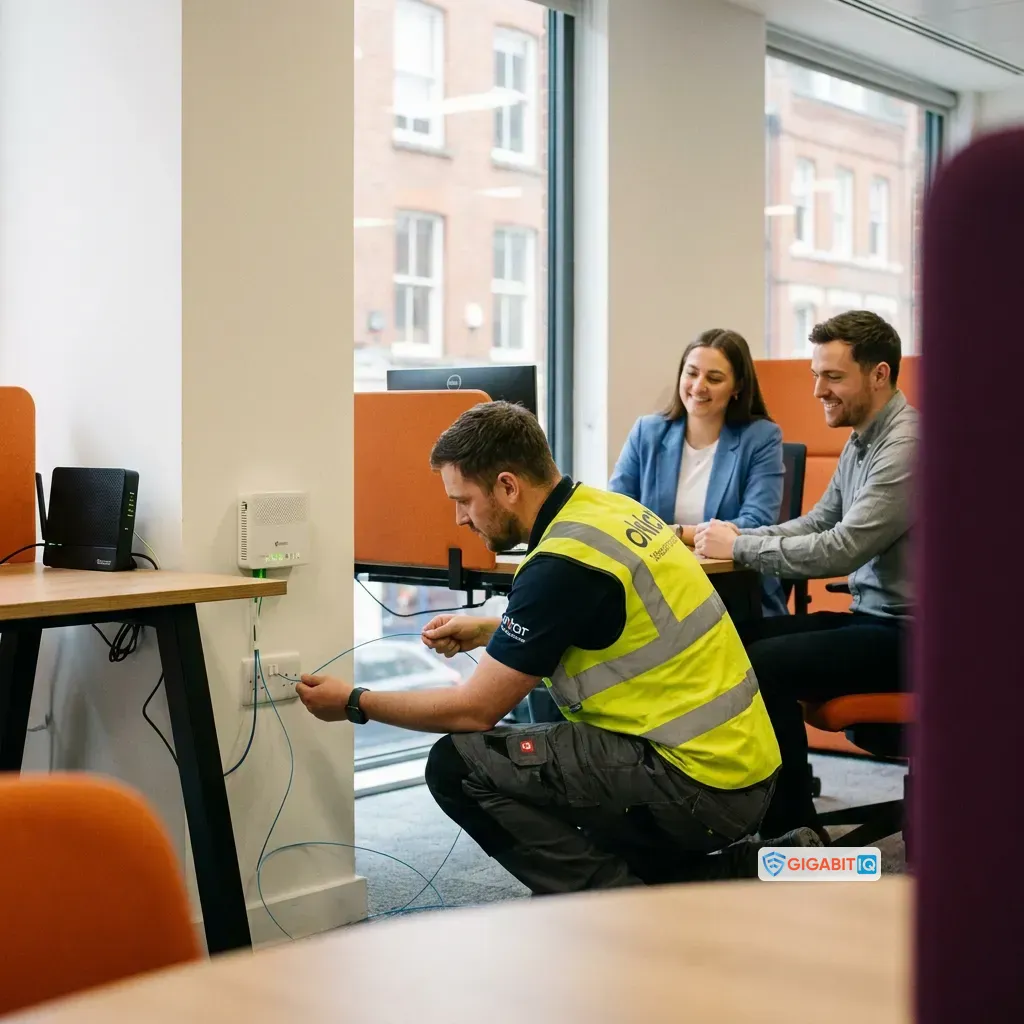
In the Openreach installation described, the engineer needs access inside the premises after completing external work to fit the internal equipment. Openreach describes the ONT (Optical Network Terminal) as a white box that connects the fibre-optic cable and provides access to the Full Fibre network in the property. Openreach says the wall-mounted ONT and router need to be close to each other.
Your intended router position is a practical starting point for a conversation about the ONT. Think about where you expect the connection to be used, then ask the provider or installer whether a proposed ONT position can work at your premises. The need for the ONT and router to be close together informs that discussion; it does not prescribe one location for every site.
Describe any limits that could affect a proposed position. The area might be difficult to access, belong to a shared part of the building, or raise a question about where equipment can be mounted. Ask what options are available if your preferred arrangement is not suitable and what you need to decide before work begins. Do not assume that a particular wall, room or cable route will be used.
You can keep the discussion focused on three points:
- Where do you expect to use the business connection?
- What possible ONT position would keep it close to the router?
- What access or building conditions could affect those positions?
A proposed location is a starting point for discussion, not a guarantee that it can be used. Write down any alternative that the provider or installer discusses and note whether you need to involve another person before settling the arrangement. That gives you a clear question to resolve without treating a general equipment description as a site plan.
Ask the provider how testing and handover will be confirmed
Testing and handover are details to settle with your provider for your business connection. Ask what checks will be performed, how you will be told whether the service is ready to use, and what to do if it is not working as expected. Do not infer a particular testing routine from the term Full Fibre alone.
A useful handover discussion makes the end point clear. Ask the provider:
- What will be checked before the installation is treated as complete?
- How will you know whether the connection is ready for your business to use?
- Is there anything you need to do to connect your own equipment or start using the service?
- If the connection does not work as expected, who should you contact and what information should you have ready?
- Will the outcome and any next steps be explained before the installer leaves?
These questions do not presume that every provider uses the same checks or communicates the outcome in the same way. They help you understand the process that applies to your connection. If an answer depends on your equipment or site, ask which part you need to arrange and who will confirm it.
You do not need to devise a technical test for the installer.
Before work is arranged, identify the site-specific questions
A useful installation plan puts the unresolved site questions and the person responsible for each one in a single place. Before work is arranged, note:
- Connection type: Is the planned connection Full Fibre to the premises or FTTC with copper on the final stretch?
- External route: What work remains outside, and what access or route details still need clarification?
- Building coordination: If the premises are shared, who handles permission, surveys and access?
- Appointment: What date has been agreed, and who can provide the required access?
- Indoor equipment: What position is being discussed for the ONT and router, and what conditions could affect it?
- Testing and handover: What will be checked, how will readiness be explained, and who should you contact if something is not working?
Not every point will apply to your premises. Mark each one as settled, not applicable or still to be answered, and name who will follow up on any open question.
With the site questions clear, you can move on to considering the relevant package.
What should a business ask before its fibre installation?
Will a full-fibre installation always involve digging outside the premises?
Not necessarily. Community Fibre says it usually runs its street cabling through existing ducts beneath roads or pavements, but that describes its process—not a guaranteed route for another provider or site. Ask what outside work, if any, remains and which areas may need access.
How long does a business full-fibre installation take?
There is no single appointment length to assume: the work can depend on the provider, property and site arrangements. Ask your provider what to expect for your premises and who needs to be available to provide access.
What should I ask if the business is in a shared building?
Find out who can discuss permission and access for the building, such as the relevant landlord, freeholder or managing agent. Ask whether a survey or coordination with that person is needed before the work can be planned; arrangements can vary by building.


